×

The Standard e-Paper
Truth Without Fear





Audio By Vocalize
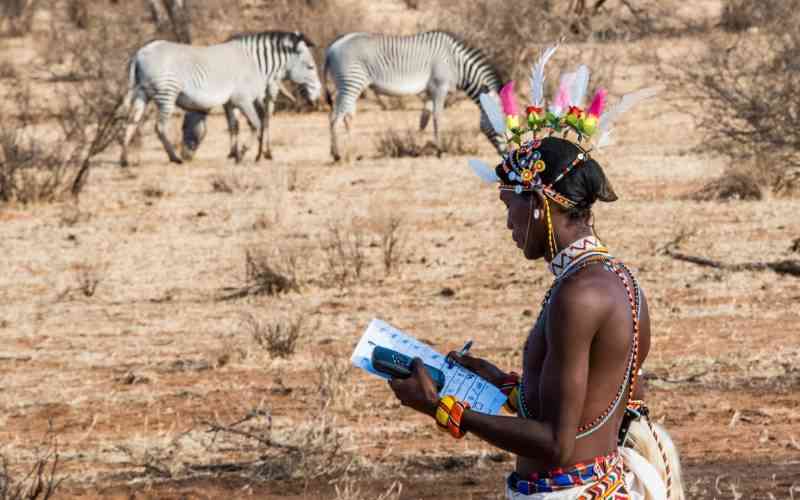
A community wildlife Moran monitor records Grevy’s zebra sightings during a routine patrol in northern Kenya. [Courtesy]
The first thing that catches your eye is not its stripes, but its ears. They are unusually large and rounded, standing upright against the backdrop of northern Kenya’s endless plains. Then come the impossibly narrow black-and-white stripes running all the way to its hooves, wrapped around a body taller and more muscular than the zebra most people know.
At first glance, it looks like just another zebra. It is anything but ordinary. The Grevy’s zebra (Equus grevyi) is the largest of the world’s three surviving zebra species, alongside the plains zebra (Equus quagga) and the mountain zebra (Equus zebra). It is also the rarest. Fewer than 3,000 remain in the wild, earning it an Endangered listing on the International Union for Conservation of Nature (IUCN) Red List.
Its name dates back to 1882, when Emperor Menelik II of Ethiopia presented one of the animals as a diplomatic gift to French President Jules Grévy. Scientists later named the species in his honour.
More than a century later, the Grevy’s zebra has become far more than a historical curiosity. It is one of the world’s most endangered large mammals, and its future rests largely on Kenya’s shoulders.
More than 90 per cent of the remaining population lives in Kenya’s arid and semi-arid lands, from Samburu and Marsabit to Isiolo and parts of Laikipia, with only a small, declining population surviving in southern Ethiopia.
Once widespread across the Horn of Africa, the species has vanished from much of its historic range as habitat loss, prolonged drought, disease, competition with livestock and fragmented landscapes have steadily pushed it towards extinction.
Unlike the familiar plains zebra commonly seen in Kenya’s parks, Grevy’s zebras are elusive. Finding one demands patience, rough journeys across unforgiving terrain and, quite often, hours of walking under temperatures that can soar beyond 40 degrees Celsius.
That search led us to Laisamis in Marsabit County. Stretching across volcanic plains, rocky hills and dry riverbeds, the landscape appears unforgiving. Rain is scarce and unreliable. When it falls, much of it disappears almost as quickly as it arrives, leaving behind brittle grass and dusty earth.
Climate change has deepened the challenge. Longer, harsher droughts have reduced pasture, dried seasonal rivers and intensified competition for water between wildlife and livestock.
Yet despite these harsh conditions, Grevy’s zebras continue to survive here, largely because these community landscapes still offer something becoming increasingly rare elsewhere: space to move.
Many people assume endangered wildlife survives mainly inside national parks. The opposite is true for the Grevy’s zebra. Most of its population lives outside protected areas, roaming community conservancies and pastoral rangelands before moving into nearby reserves such as Samburu, Buffalo Springs and Shaba when the dry season tightens its grip.
That is why saving the Grevy’s zebra has never been about protecting a park. It has become about protecting an entire landscape and the communities that share it.
“Conservation cannot happen without the involvement of the community,” says Aloyce Gonzaga Lekuton, Director for Programmes at the Grevy’s Zebra Trust.
“We work with communities because that is where the Grevy’s zebra is. This is not a one-man effort. It requires local people, conservation organisations and government working together.”
Across Marsabit, Samburu, Isiolo and now Laikipia, the Trust has built its conservation model around the people who live alongside the endangered species. Former livestock herders monitor wildlife using smartphone applications. Women restore degraded grasslands and harvest indigenous grass seed. Community champions work with elders to protect grazing areas, while researchers use technology to monitor individual animals across vast landscapes.
Together, they are proving that saving one of Africa’s rarest mammals depends as much on people as it does on wildlife.
For 25-year-old Fereiti Moga, conservation begins long before sunrise. By 5 am, the Samburu moran is already on foot, smartphone in hand, setting off across the rocky plains of Laisamis. His assignment is simple on paper but demanding in reality: find Grevy’s zebras and record everything he sees.
“I record all wildlife, not just the Grevy’s zebra,” he says. “If I see elephants, giraffes, monkeys or any other wild animal, I record them too. When I meet herders, I ask whether they have seen Grevy’s zebras and I add that information into the app.”
The application relies largely on photographs rather than written text, allowing trackers with different literacy levels to identify species, record numbers, note the presence of foals and capture locations with remarkable accuracy. Every sighting, or even the absence of one, helps researchers build a clearer picture of where the endangered animals are moving and how they are faring.
Each day the team takes a different route, slowly piecing together the movements of a species scattered across one of Kenya’s harshest landscapes.
“The sun is very hot, there is little water and we walk long distances,” Fereiti says. “But I was a herder before, so walking is something I have always done.”
The difference, he adds with a laugh, is that livestock follow you home. Wild animals do not.
For him, the job has become more than employment. It has changed how he sees an animal he once knew very little about.
“Before joining the programme, I didn’t understand why the Grevy’s zebra was important. Now I know its value to our environment and to our community.”
His most vivid memory is not of finding large herds but of witnessing the devastating 2023 drought, when months without meaningful rainfall stripped the landscape bare.
“The land had nothing left,” he recalls. “The Grevy’s zebras became so thin because there was nothing to eat. Every time I saw them, I felt bad. I didn’t even want to look at them struggling.”
The drought exposed how vulnerable the species has become. Although Grevy’s zebras are naturally adapted to dry environments and can survive longer without water than plains zebras, prolonged droughts, shrinking pasture and increasing competition with livestock continue to threaten their survival. Lactating mares are especially vulnerable because they must drink regularly to produce enough milk for their foals.
For fellow Moran Keno Galhaile, tracking Grevy’s zebras has become a lesson in understanding an animal few people ever get close enough to observe.
“When you herd livestock, the animals follow you,” he says. “With Grevy’s zebras, you have to find them where they are.”
Over time, he has learnt their routines. During the dry season, they often visit water points at dawn or dusk, avoiding the busiest periods when livestock crowd the same sources. They are naturally wary of strangers but gradually become accustomed to the familiar faces of the morans who monitor them almost every day.
He has also learnt just how sensitive they are to disturbance.
“If something blocks their usual path, even a piece of cloth, they may abandon that route,” he says. “When we find something blocking where they normally pass, we remove it.”
One encounter has stayed with him.
“I once found a young foal alone after it had become separated from its mother,” he recalls. “I immediately called the Grevy’s Zebra Trust so they could come and rescue it.”
For Mangesian Landeri, 27, conservation extends beyond tracking hoofprints across the sand. He also visits manyattas, speaking with herders and elders who often become the first to spot Grevy’s zebras moving through the landscape. Their knowledge complements what the morans record in the field, creating a network of information that stretches far beyond what researchers could gather on their own.
“Some days we find 10 Grevy’s zebras. Some days we find none,” he says. “But even when we record zero, that information is important. All our records add up to help protect the fewer than 3,000 Grevy’s zebras left in the world.”
The information collected by the morans does not simply disappear into a database. It becomes part of one of the world’s most comprehensive wildlife monitoring systems for the endangered species, helping researchers understand where individual zebras move, where foals are born and how populations change over time.
Every Grevy’s zebra carries a unique stripe pattern, much like a human fingerprint. Using photographs captured in the field, researchers can identify individual animals through specialised Stripe ID software, allowing them to distinguish between zebras already recorded and newly sighted ones.
Unlike the long, exhausting treks across the vast landscapes of Laisamis, monitoring in Wamba, Isiolo County, tells a slightly different story.
Here, Grevy’s zebras often move much closer to neighbouring communities and protected areas, frequently sharing water points and grazing grounds with livestock. While the conservation challenges remain, researchers do not always have to walk for hours before encountering the animals.
At one restored water point, hidden camera traps quietly document every visitor.
“We use the cameras to know how many Grevy’s zebras are coming to drink, whether they have enough access to water and whether livestock are competing for the same resource,” explains Gabriel Ikinila, Research Officer at the Grevy’s Zebra Trust.
The cameras operate day and night, capturing hundreds of images that are later analysed using Stripe ID software to identify individual zebras from their distinctive markings.
Water, Gabriel says, has become one of conservation’s greatest priorities.
Years ago, the seasonal river flowing through Wamba would dry up completely once the rains ended. Today, restored sand dams trap rainwater beneath the riverbed, storing it underground long after the surface has dried. Wells and shallow springs now provide water for wildlife, livestock and neighbouring communities throughout much of the dry season.
“Before, this river only had water during the rainy season,” Gabriel says. “Now the sand dams hold water beneath the sand. Wildlife, livestock and people all benefit.”
Reliable water has also reduced pressure on artificial pumping systems that conservationists previously relied on during severe dry spells, allowing Grevy’s zebras to return to their natural watering points with less disturbance.
Protecting the species, however, means ensuring there is enough pasture once the animals reach those water sources.
Several kilometres away in Westgate Conservancy, Eunice Nolkurupu Lesootia is doing exactly that.
For the past seven years, the 48-year-old has worked as a Grassland Champion, restoring degraded rangelands by digging semi-circular bunds that capture rainwater before sowing indigenous grass seed.
“When the rains come, the water stays inside the bunds and the grass grows,” she explains. “That grass feeds livestock and wildlife, especially the Grevy’s zebra, so they do not have to travel far looking for pasture.”
The restored grasslands provide more than food for wildlife.
Once mature, the grass is harvested, purchased by the Grevy’s Zebra Trust and later returned to communities as fodder reserves. Women also harvest grass seed, creating another source of income that helps pay school fees and meet household needs.
The work has transformed more than the landscape.
“We have gained knowledge and confidence,” Eunice says. “Women now have a chance to speak and even become leaders. Before, we were rarely recognised. Today, our voices are heard.”
Communities have also begun setting aside buffer grazing zones where pasture is allowed to regenerate naturally, reducing the need to move livestock long distances during drought and easing pressure on fragile rangelands.
For Joshua Labarakwe, the Laisamis Regional Coordinator at the Grevy’s Zebra Trust, these community-led efforts are the foundation of conservation.
“We cannot protect the Grevy’s zebra by ourselves,” he says. “These animals share the same land, pasture and water with people. Unless communities understand why they matter, conservation cannot succeed.”
That philosophy shapes how the Trust recruits the young morans who now monitor wildlife across northern Kenya.
Rather than advertising jobs or conducting conventional interviews, the organisation begins with community elders, who recommend disciplined young men they believe can take on the responsibility.
“They know these young men better than anyone,” Joshua says. “We first build discipline, then train them in wildlife monitoring, data collection and community engagement.”
Many of the recruits once spent their days herding livestock across this same rugged terrain. Today, that deep knowledge of seasonal rivers, grazing grounds and wildlife movements has become one of conservation’s greatest strengths.
“They know this landscape better than anyone,” Joshua says. “They can reach places vehicles cannot. That local knowledge is something you cannot teach.”
Their responsibilities now stretch far beyond monitoring Grevy’s zebras. They visit schools, hold community meetings and speak with fellow morans about the importance of protecting wildlife. In places once associated with cattle rustling and conflict, conservation has also created new livelihoods and a renewed sense of purpose for many young men.
For communities that have lived alongside the Grevy’s zebra for generations, protecting one of the world’s rarest mammals is no longer seen as someone else’s responsibility. It has become part of everyday life.
Across northern Kenya, Grevy’s zebra numbers have stabilised after decades of decline, a sign that community-led conservation is beginning to reverse years of losses. Yet the species remains endangered, and the threats that pushed it to the brink have not disappeared.
Habitat fragmentation continues to shrink traditional migration routes as settlements expand and fencing spreads across rangelands. Livestock numbers have increased, intensifying competition for pasture and water, while prolonged droughts linked to climate change continue to test the resilience of both wildlife and pastoral communities. Disease outbreaks also remain a constant risk where wildlife and livestock share grazing grounds.
Historically, Grevy’s zebras were also hunted for their skins and meat. In parts of the Horn of Africa, hunting contributed significantly to their decline before legal protection was strengthened, underscoring how vulnerable the species once was to human exploitation.
For Aloyce Gonzaga Lekuton, protecting the Grevy’s zebra has never been about the animal alone.
“If communities do not benefit, conservation cannot last,” he says. “When people see that protecting wildlife also strengthens livelihoods, education, grasslands and water resources, then conservation becomes something they own.”
That thinking has shaped programmes extending beyond wildlife monitoring. Women now produce reusable sanitary pads distributed to vulnerable girls through the Trust’s Ng’ireten initiative. Community dialogue forums bring together elders, morans and local leaders to discuss conservation alongside natural resource management. Grassland restoration improves pasture not only for Grevy’s zebras but also for livestock, reducing pressure during droughts.
Every intervention, Aloyce says, is guided by one principle: healthy communities are more likely to protect healthy ecosystems. The model is now attracting growing interest from conservation organisations seeking ways to protect wildlife beyond the boundaries of protected areas.
Every year, that message reaches an even wider audience through the Lewa Safari Marathon, one of Kenya’s best-known conservation fundraising events.
Held annually at Lewa Conservancy, the Lewa Safari Marathon has raised millions of dollars for wildlife conservation, education, healthcare and community development across northern Kenya. Part of those proceeds supports programmes benefiting endangered species such as the Grevy’s zebra through habitat restoration, wildlife monitoring, water projects and community-led conservation.
It serves as a reminder that saving endangered wildlife is not the responsibility of scientists and conservationists alone. Ordinary people, whether running a marathon or restoring a grassland, all become part of the same effort.
Across Samburu and Isiolo counties, that approach has evolved into a community-led conservation network. Grevy’s Zebra Trust now works through three community groups, each playing a distinct but interconnected role. There are the young morans who monitor wildlife, women who restore degraded grasslands, and experienced community champions who guide rangeland management and conservation education. Each addresses a different challenge, yet all are working towards the same goal: ensuring Grevy’s zebras continue roaming northern Kenya’s dry landscapes.
Fewer than 3,000 Grevy’s zebras remain in the wild. Every foal born matters. Every grassland restored matters. Every water point protected matters. Every photograph uploaded by a moran matters.
Saving the world’s rarest zebra is no longer the work of scientists alone. Across northern Kenya, entire communities have made conservation part of everyday life. Every foal born, every water point restored, every hectare of grassland revived and every wildlife sighting logged by a moran brings the Grevy’s zebra one step farther from extinction.
Subscribe to our newsletter and stay updated on the latest developments and special offers!